
Why sequencing matters in Anchorage
In Anchorage, the freeze–thaw cycle, groundwater behavior, and short summer windows add pressure to get this sequence right. That’s where a local team like Excavate Alaska adds value: aligning land prep, grading, and utility work with the season, soil conditions, and your build plan, so your team feels equipped to handle local challenges.
The seasonal window, at a glance
- Spring (thaw): assess drainage issues, set the staging plan, book crews and utilities.
- Summer (dry): primary window for land preparation, trenching, and grading.
- Fall (pre-freeze): lock in final grading, stabilize slopes, and button up utilities.
- Winter: limited exterior earthwork; focus shifts to planning and interior phases.
Pre-design due diligence (before any machines roll)
- Survey & site plan: confirm boundaries, setbacks, easements, and the final elevations.
- Soils & drainage review: note low spots, water flow paths, and seasonal groundwater.
- Access & staging: plan haul routes, spoil areas, and material stockpiling locations.
- Permits & utilities coordination: confirm trench depths, bedding, inspections, and call-before-you-dig requirements.
Tip: Getting drainage right on paper first avoids moving dirt twice.
Phase 1 — Site clearing & safe access
- Remove brush, organics, and unstable topsoil.
- Establish a stable construction entrance to reduce tracking and rutting.
- Protect trees or features you want to keep.
This step sets the stage for accurate grading and prevents mud from getting in your way later.
Phase 2 — Rough grade with drainage in mind
Rough grading shapes the land to move water away from the future structure. Targets vary by lot, but think in terms of a positive slope from the building pad to approved outlets and controlled flow.
If the site shows chronic wet areas, bring drainage solutions into the plan now. For soggy or perched-water sites, consider a French drain network, daylighted swales, or subsurface collection tied to suitable outfalls.
Phase 3 — Building pad & foundation subgrade
- Strip organics from the pad footprint.
- Bring in suitable fill as needed and compact in lifts to spec.
- Verify pad elevation vs. finished floor and surrounding grades.
A well-built pad resists settlement and frost heave. Skipping compaction is the fastest path to foundation problems and cracked flatwork.
Phase 4 — Trenching for water, sewer, and utilities
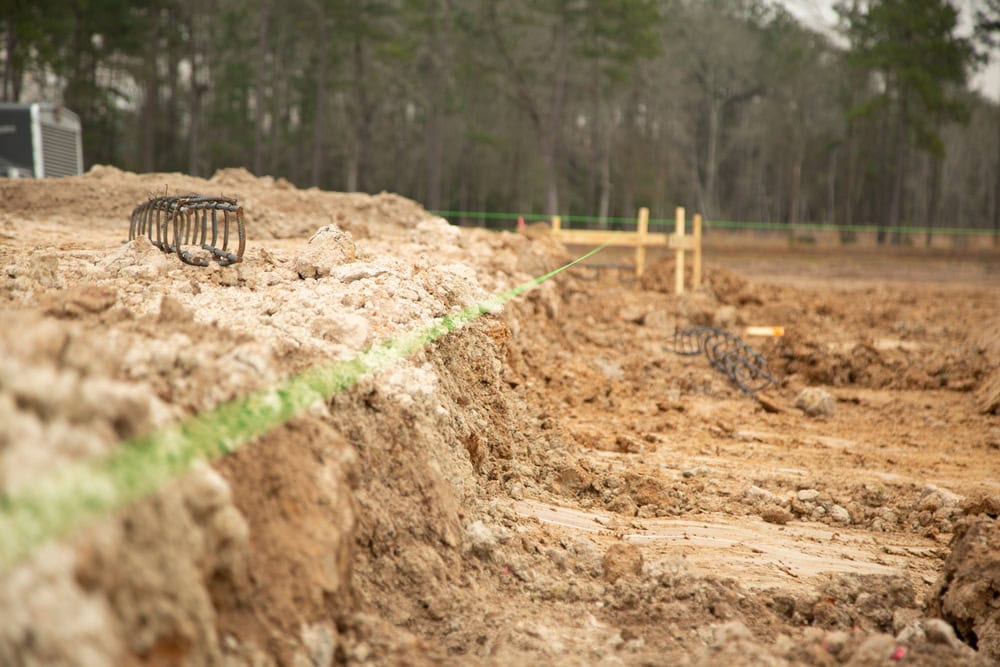
With the rough grades set, trenching can proceed without guessing at final depths. Typical order:
- Water & sewer main lines to the structure (deepest trenches first).
- Secondary utilities (electric, gas, telecom) with required separations and warning tape.
- Bedding, pipe placement, slope checks, pressure or flow tests as required.
- Initial backfill and compaction, keeping trench crowns slightly high to allow minor settlement.
Coordinate inspections at each milestone. It’s far cheaper to pause for an inspection than to reopen a trench.
Phase 5 — Drainage features (if needed)
If your plan includes French drains, daylighted outlets, curtain drains, or dry wells, install them once the primary utility trenches are stable. This ensures you won’t cut through fresh drain lines later. Where slopes are involved, integrate slope stabilization—think geotextiles, terracing, or vegetation—before the first major storm tests your work.
Phase 6 — Retaining walls and stabilization
Install retaining walls before final grading so you can tie base course, drainage pipe, and backfill into the surrounding subgrade. Proper wall drains and geogrid (as specified) are not optional; they prevent wall movement and relieve hydrostatic pressure during freeze–thaw.
Phase 7 — Subgrade for hard surfaces
Prepping for hardscape is its own mini-sequence:
- Concrete sidewalks and entries: uniform subgrade, compacted base, and drainage falls that shed water away from structures.
- Paths or pads: ensure separation from topsoil and organic layers; keep water moving around—not under—the slab.
Phase 8 — Final grading & soil conditioning
Now the site is ready for the final grade: smooth the surface, set finish elevations, and direct runoff safely. If you’ll be installing a lawn, condition the topsoil so it drains well but holds enough moisture to support turf establishment. This is also the moment to finesse swales and surface contours to keep foundations dry.
Inspections and touchpoints to schedule early
- Trench depth, bedding, and pipe slope verifications.
- Pressure or flow tests for water and sewer.
- Your jurisdiction requires backfill and compaction checks.
- Final drainage review before you seed, sod, or pave.
Putting these on the calendar early avoids last-minute bottlenecks.
Common sequencing mistakes (and quick fixes)
- Installing utilities before rough grading. Fix: rough grade first, so trenches hit the right elevations.
- Backfilling without compaction. Fix: compact in thin lifts; test if specs call for it.
- Skipping drainage details. Fix: plan swales and drains with finished elevations in mind.
- Pouring concrete on soft subgrade. Fix: rebuild the base and verify compaction before forms go in.
- Final grading is too early. Fix: wait until heavy work and utility tie-ins are finished.
A sample 10–14 week summer sequence
Your project may be faster or slower based on lot size and inspections, but this gives a feel for order:
- Week 1–2: Clearing, access road, staging set-up, rough grade begins.
- Week 3–4: Pad build and compaction; drainage layout refined on site.
- Week 5–6: Trenching for water/sewer, tests and inspections, initial backfill.
- Week 7–8: Secondary utilities, final backfill, start retaining walls if needed.
- Week 9–10: Drainage features (French drains, swales), stabilization on slopes.
- Week 11–12: Subgrade for sidewalks/pads; formwork planning.
- Week 13–14: Final grading, soil conditioning; prep for lawn or surface finishes.
Weather shifts can compress or stretch this window. Anchorage crews plan around rain events to protect open trenches and subgrade.
How Excavate Alaska keeps your schedule tight
- One accountable site partner. Land prep, grading, trenching, and drainage are coordinated under one roof.
- Alaska-tested methods. Equipment, crews, and sequences suited to local soil and seasonal conditions.
- Clear milestones. You’ll know what’s next, what’s inspected, and what’s ready to build on.
If you want help with land preparation, see our service page here: Land Preparation. For full-site support, start at Excavate Alaska.
Quick checklist you can print
- Survey complete and elevations set
- Drainage plan tied to finished floor elevation
- Clearing & access road in place
- Rough grade done, pad built, and compacted
- Utility trenches dug (deepest first), tested, and inspected
- Backfill compacted, crowns left slightly high
- Retaining walls and drains installed
- Subgrade prepped for concrete/paths
- Final grade shaped; soils conditioned
- Lawn or surface finishes scheduled
FAQs
1) What comes first: grading or utilities?
Start with rough grading to set trenches to the correct depths and slopes. Then trench for water/sewer, followed by other utilities, and finish with final grading.
2) How do I prevent water problems around the foundation?
Plan a positive slope away from the structure, use swales where needed, and add drains if the site shows chronic saturation. Final grade should keep water moving—not pooling.
3) When should French drains be installed?
After primary utilities and initial backfill, but before final grading, this keeps the drain layout intact and tied to real, on-site elevations.
4) Can I pour concrete sidewalks before final grading?
Not recommended. Prep the subgrade and confirm drainage first. Pouring too early risks ponding at slab edges and heaving during freeze–thaw.
5) What’s the biggest scheduling risk in Anchorage?
Weather around the thaw and early fall. Protect open trenches, maintain access roads, and book inspections in advance to avoid delays.

As the owner and founder of Excavate Alaska, I’m passionate about delivering reliable, high-quality excavation services to the Anchorage community and beyond. With over a decade of hands-on experience in the industry, I’ve built Excavate Alaska on the values of integrity, professionalism, and customer-first service. My team and I specialize in site preparation, land clearing, grading, trench digging, and full-scale excavation for both residential and commercial projects.