
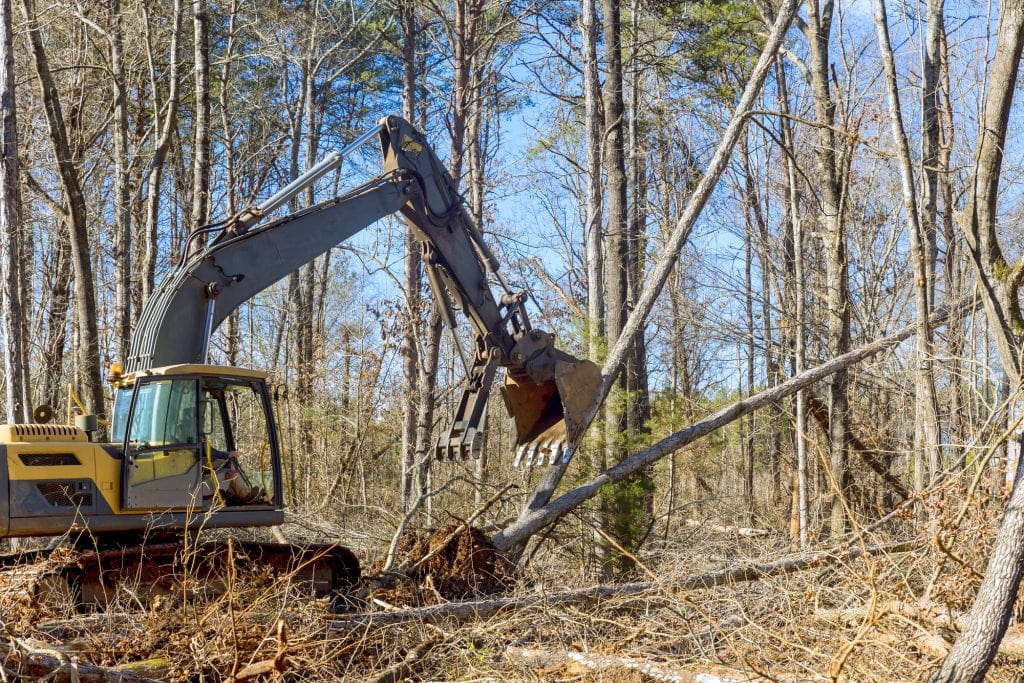
Prepping a lot and hearing both terms? Here’s what you’ll learn: how land grubbing differs from land clearing, why grubbing matters on Anchorage sites, what it costs, and when your project needs it.
Land grubbing in Anchorage is the removal of stumps, roots, and buried organic material after the trees and brush are gone—clearing takes down what’s above ground, grubbing removes what’s below it. You usually need both: clearing opens the site, and grubbing makes it stable enough to build on. Skipping grubbing is what causes settling, soft spots, and drainage problems once organic material rots underground.
What is the difference between land clearing and land grubbing?
Land clearing removes surface vegetation—standing trees, brush, and undergrowth. Land grubbing goes deeper, extracting the stumps, root balls, and buried wood and organic soil left behind. Think of clearing as cutting the site down and grubbing as cleaning it out. On most Anchorage build sites the two happen back-to-back, but they’re distinct steps with different equipment and goals.
| Land clearing | Land grubbing | |
|---|---|---|
| Removes | Trees, brush, undergrowth | Stumps, roots, buried organic material |
| Depth | At and above ground | Below ground |
| Goal | Open the site | Stabilize the soil |
| Equipment | Saws, mulchers, dozers | Excavators, grubbing rakes, grapples |
| When | First | Right after clearing |
Why does land grubbing matter on Anchorage lots?
Buried roots and organic material decompose over time, and when they do, the ground above them settles. Under a driveway, slab, or foundation, that settling means cracks, dips, and uneven surfaces. South Central Alaska’s freeze-thaw cycles and moisture make it worse, because organic pockets hold water that heaves when it freezes. Proper grubbing also improves drainage and erosion control—our post on how land grubbing helps prevent drainage and erosion issues explains why removing that material protects the whole site.
How much does land grubbing cost in Anchorage?
Grubbing cost depends on stump count and size, root density, soil and rock conditions, and how much material must be hauled away. A lot with a few small stumps grubs quickly; a densely forested site with mature spruce and heavy root systems takes more excavator hours and disposal. Because grubbing and clearing are often done in the same mobilization, bundling them usually lowers the total cost.
- Stump count and size — bigger, older stumps take longer
- Root density — mat-forming roots slow extraction
- Soil and rock — cobble and frozen ground add time
- Haul-off — disposal of stumps and organic material adds cost
When does your project need grubbing, not just clearing?
You need grubbing any time something will be built or paved on the cleared ground:
- Foundations and slabs — settling under a structure is costly to fix.
- Driveways and parking — organic pockets cause dips and potholes.
- Retaining walls and grading — stable subgrade is essential.
- Lawns and landscaping — roots and debris interfere with grading and growth.
If you’re only opening up sightlines or reducing wildfire fuel and won’t build on the area, clearing alone may be enough. For anything structural, grubbing is not optional. Professional land grubbing services make sure the subgrade is ready. Rural building lots in Wasilla and the Mat-Su often carry heavy root systems that make thorough grubbing especially important.
Which is right for your site?
For a full build, plan on clearing and grubbing together, then rough grading—done in one mobilization to save money and shape the site once. For a view-clearing or fuel-reduction project with no construction, clearing alone may do. When in doubt, grub: the cost of removing roots now is far less than repairing a settled foundation or driveway later.
Ready to prep your lot? Request an estimate
Excavate Alaska proudly serves Anchorage and South Central Alaska—including Eagle River, Chugiak, Girdwood, Wasilla, and Palmer (plus the wider Anchorage metro and Matanuska-Susitna Borough). We handle clearing, land grubbing in Anchorage, and grading so your site is stable and build-ready. Call (907) 336-7434 or visit our contact page to request an estimate.
Frequently Asked Questions
What is the difference between land clearing and land grubbing?
Land clearing removes surface vegetation like trees, brush, and undergrowth, while land grubbing removes what’s below ground—stumps, roots, and buried organic material. Clearing opens the site and grubbing stabilizes the soil beneath it. Most build projects need both steps done back-to-back.
Why is land grubbing important before building in Anchorage?
Buried roots and organic material decompose over time, causing the ground to settle and creating cracks, dips, and drainage problems under structures and driveways. Anchorage’s freeze-thaw cycles worsen this because organic pockets trap water that heaves when frozen. Grubbing removes that material so the subgrade stays stable.
How much does land grubbing cost in Anchorage?
Cost depends on the number and size of stumps, root density, soil and rock conditions, and how much material must be hauled away. Bundling grubbing with clearing in one mobilization usually lowers the total. Request a site-specific estimate for accurate pricing.
Do I always need grubbing after clearing?
Not always. If you’re only clearing for views or wildfire fuel reduction and won’t build on the area, clearing alone may be enough. But for anything structural—foundations, driveways, retaining walls, or graded lawns—grubbing is essential to prevent settling.
Can land clearing and grubbing be done at the same time?
Yes, and it’s usually the smart choice. Doing both in one mobilization lets crews shape the site once, reuse or dispose of material efficiently, and lower the overall cost compared with scheduling them separately.

As the owner and founder of Excavate Alaska, I’m passionate about delivering reliable, high-quality excavation services to the Anchorage community and beyond. With over a decade of hands-on experience in the industry, I’ve built Excavate Alaska on the values of integrity, professionalism, and customer-first service. My team and I specialize in site preparation, land clearing, grading, trench digging, and full-scale excavation for both residential and commercial projects.